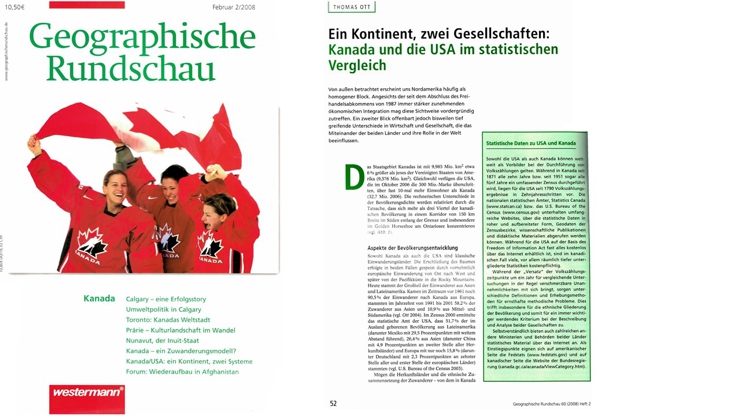
OTT, Thomas (2008): Ein Kontinent, zwei Gesellschaften: Kanada und die USA im statistischen Vergleich. Geographische Rundschau 60 (2), 52-57

Kurzfassung

Von außen betrachtet erscheint und Nordamerika häufig als homogener Block. Angesichts der seit dem Abschluss des Freihandelsabkommens von 1987 immer stärker zunehmenden ökonomischen Integration mag diese Sichtweise vordergründig zutreffen. Ein zweiter Blick offenbart jedoch bisweilen tief greifende Unterschiede in Wirtschaft und Gesellschaft, die das Miteinander der beiden Länder und ihre Rolle in der Welt beeinflussen.

Volltext

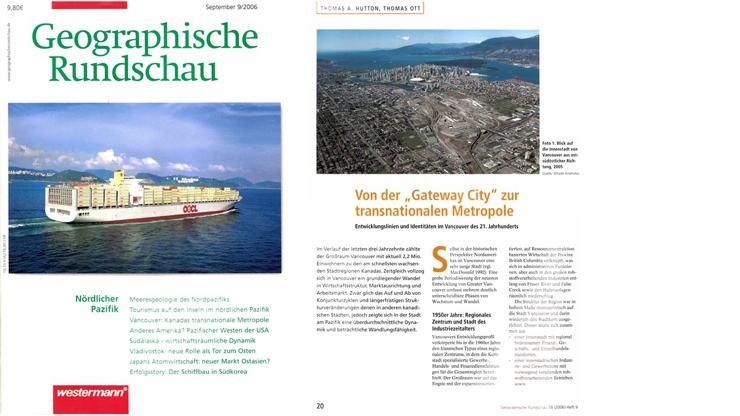
HUTTON, Thomas / OTT, Thomas (2006): Von der “Gateway City” zur transnationalen Metropolis: Vancouver im 21. Jahrhundert. Geographische Rundschau 58 (9), 20-28

Kurzfassung

Over the past four decades Vancouver has undergone a series of transformational changes in development orientation, industrial structure, and urban identity. During this period, Greater Vancouver has also experienced fundamental changes with respect to the region’s industrial mix, economic base, labour force, market orientation, and overall development trajectory. The essay comprises a short profile of sequences of defining changes over the last decades of the 20th century; and, secondly a characterization of ist current development, emphasizing changes in Vancouver’s external relations, as well as the importance of the central city as a marker of transformative change.

Volltext

OTT, Thomas (2004): Are Canadian Cities Becoming More American? Evidence from the West. Zeitschrift für Kanada-Studien 24 (1), 162-175

Kurzfassung

Der Beitrag stellt zunächst vier grundlegende Konzepte und Interpretationen (kontinentalistisch, nationalistisch, konvergent, regionalistisch) des Gegensatzes zwischen kanadischen und US-amerikanischen Städten vor. Es schließt sich eine kurze Diskussion des Regulationsansatzes bezüglich seiner Eignung als theoretisches Konzept zur Strukturierung des Stadtvergleichs an. In der fordistischen Periode war die Stadtentwicklung in Kanada und den USA durch spezifische, nationale Regulationsweisen und Akkumulationsregimes geprägt und brachte somit divergente Stadtstrukturen hervor. Demgegenüber herrschen in der post-fordistischen Formation konvergente Tendenzen vor. Nationale Unterschiede werden durch die Angleichungskräfte der Globalisierung verringert oder gänzlich abgebaut. Auf dieser theoretischen Basis aufbauend gibt der dritte Teil einen Überblick post-fordistischer bzw. postmoderner Elemente in den Stadtlandschaften des kanadischen Westens. Der Aufsatz schließt mit einer vorläufigen Antwort auf die im Titel formulierte Frage; die auf eine konvergente Entwicklung zielenden Argumente des Papiers werden um eine regionalistische Perspektive ergänzt.

Volltext

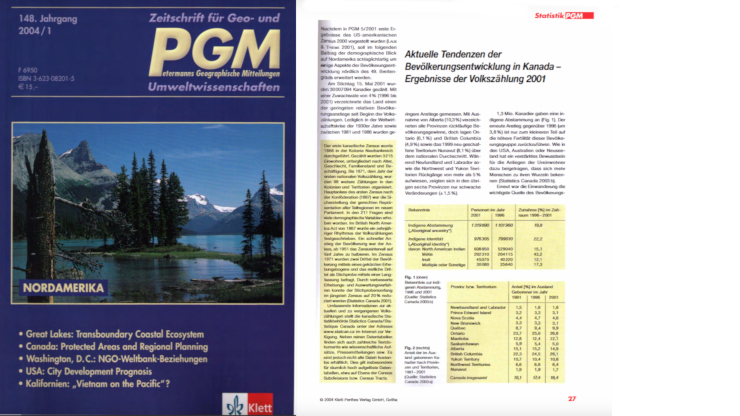
OTT, Thomas (2004): Aktuelle Tendenzen der Bevölkerungsentwicklung in Kanada – Ergebnisse der Volkszählung 2001. Petermanns Geographische Mitteilungen 148 (1), 27-29

Volltext

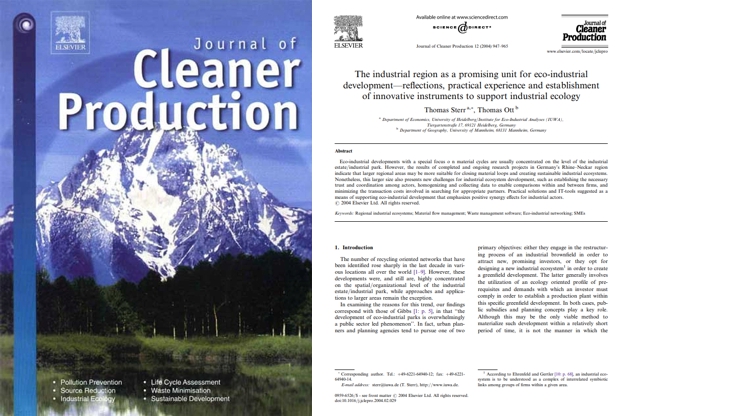
STERR, Thomas / OTT, Thomas (2004): The Industrial Region as a Promising Unit for Eco-industrial Development – Reflections, Practical Experience and the Establishment of Innovative Instruments to Support Industrial Ecology. Journal of Cleaner Production 12 (8-10), 947-965

Kurzfassung

Eco-industrial developments with a special focus on material cycles are usually concentrated on the level of the industrial estate/industrial park. However, the results of completed and ongoing research projects in Germany’s Rhine-Neckar region indicate that larger regional areas may be more suitable for closing material loops and creating sustainable industrial ecosystems. Nonetheless, this larger size also presents new challenges for industrial ecosystem development, such as establishing the necessary trust and coordination among actors, homogenizing and collecting data to enable comparisons within and between firms, and minimizing the transaction costs involved in searching for appropriate partners. Practical solutions and IT-tools suggested as a means of supporting eco-industrial development that emphasizes positive synergy effects for industrial actors.

Volltext

https://www.sciencedirect.com/science/article/pii/S0959652604000836

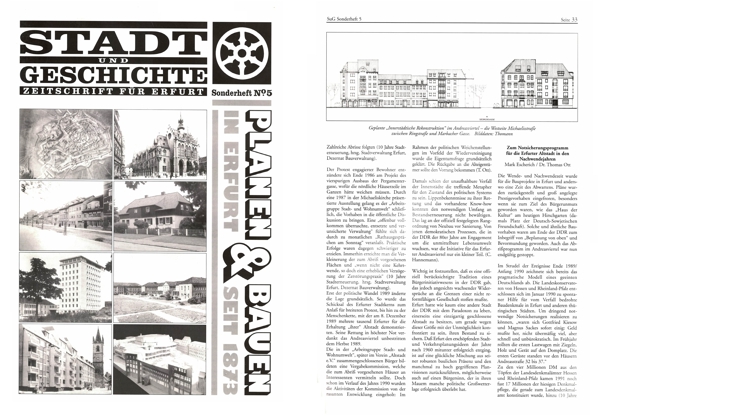
ESCHERICH, Mark / OTT, Thomas (2004): Zum Notsicherungsprogramm für die Erfurter Altstadt in den Nachwendejahren. Stadt und Geschichte, Sonderheft 5: Planen und Bauen in Erfurt seit 1873, 33-34

Volltext

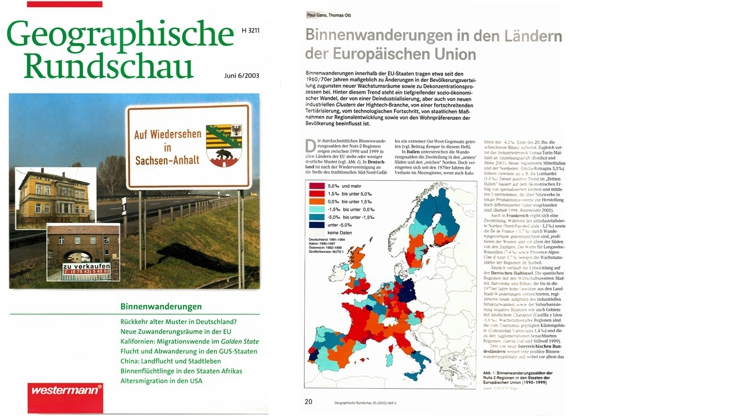
GANS, Paul / OTT, Thomas (2003): Binnenwanderung in den Ländern der Europäischen Union. Geographische Rundschau 55 (6), 20-26

Kurzfassung

Binnenwanderungen innerhalb der EU-Staaten tragen etwa seit den 1960/70er Jahren maßgeblich zu Änderungen in der Bevölkerungsverteilung zugunsten neuer Wachstumsräume sowie zu Dekonzentrationsprozessen bei. Hinter diesem Trend steht ein tiefgreifender sozio-ökonomischer Wandel, der von einer Deindustrialisierung, aber auch von neuen industriellen Clustern der Hightech-Branche, von einer fortschreitenden Tertiärisierung, vom technologischen Fortschritt, von staatlichen Maßnahmen zur Regionalentwicklung sowie von den Wohnpräferenzen der Bevölkerung beeinflusst ist.

Volltext

HÖHN, Anita / OTT, Thomas / SWIACZNY, Frank (2002): Papier oder Online? Zum Einsatz Internet-basierter Befragungen in empirischen Forschungs- und Umfrageprojekten. Standort 26 (2), 63-69

Kurzfassung

Am Beispiel einer touristischen Image- bzw. Marktuntersuchung beschäftigt sich der vorliegende Aufsatz mit den Möglichkeiten zur internet-basierten Datenerhebung im Rahmen empirischer Forschungsprojekte. Die Ergebnisse einer auf einer Zufallsauswahl basierenden schriftlichen Befragung mit Postversand und einer Befragung im Internet werden hierzu miteinander verglichen und ihre Eignung für die gewählte Zielsetzung bewertet. Die Darstellung erfolgt anhand des konkreten Fallbeispiels des Projektes „Stuttgart Regio: Touristische Infrastruktur- und Marketing-Analyse.”

Volltext

https://link.springer.com/article/10.1007/s00548-002-0075-3

OTT, Thomas (2001): From concentration to de-concentration – Migration patterns in the post-socialist city. Cities 18 (6), 403-412

Kurzfassung

The paper analyses the changing patterns of migration in the transition process from a “Socialist” into a “Capitalist” city against the background of “Modernization Theory”. Based on the example of Erfurt, a former district capital and now capital of the new federal state of Thuringia, an overview is given of basic population development trends before and after the unification of the two Germanys. A more detailed analysis of different urban areas (historic centre, city extensions of the industrial period, Socialist housing areas, new suburban housing areas) reveals a general turn-around of migration streams: Before 1990 the urban population showed a steady increase, while after reunification a dramatic loss could be observed. This decrease is caused both by emigration to areas in former West Germany, as well as by the beginning suburbanisation process. The latter is also fostered by the growing number of West – East migrants across the former internal German border. The findings are summarised in a model of the post-Socialist urban area.

Volltext

http://www.sciencedirect.com/science/article/pii/S0264275101000324

OTT, Thomas (2001): Cascadia: Zukunftswerkstatt oder verlorenes Paradies? Stadtentwicklung und grenzüberschreitende Zusammenarbeit im pazifischen Nordwesten. Geographische Rundschau 53 (1), 4-11

Kurzfassung

Due to their scenic natural location, economic prosperity, ethnic variety, as weil as a planning policy that aims for sustainability and quality of life, the ci­ties of Portland, Seattle, and Vancouver may serve as role models for future ur­ban development trends. However, the region is under threat by a rising num­ber of immigrants, both from overseas as weil as from other states or provinces. This process in turn fosters the well­known problems of urban sprawl, rising real estate prices, and increasing social tensions. Under the heading “Cascadia” politicians, academics, business people, planners, and not the least a broad range of initiatives and NGOs discuss the fu­ture of the region. Cascadia is based on three ideas: in economic terms it deals with the increasing interconnections of the metropolitan areas along lnterstate 5 (“Mainstreet Cascadia”); ecological goal is the preservation of a unique biome of geology, climate, vegetation, and wild­life (“Raincoast”); the social ideal is a peaceful and fair coexistence of different cultures (“Multiculturalism”).

Volltext