
Schlagwortarchiv für: Kanada

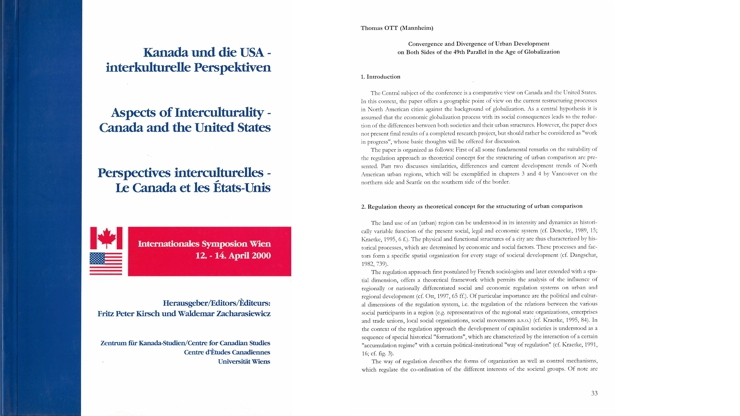
OTT, Thomas (2001): Convergence and divergence of urban development on both sides of the 49th parallel in the age of globalization. In: KIRSCH, F.P. / ZACHARASIEWICZ, W. (Eds.): Kanada und die USA – interkulturelle Perspektiven / Aspects of Interculturality – Canada and the United States / Perspectives interculturelles – Le Canada et les Etats-Unis, Vienna, 33-50

Kurzfassung

Am Beispiel der Städte Vancouver und Seattle untersucht der Vortrag Gemeinsamkeiten und Unterschiede kanadischer und U.S.-amerikanischer Städte. Als Ausgangshypothese wird dabei unterstellt, dass der ökonomische Globalisierungsprozess mit seinen sozialen Folgen zu einer Verringerung der Unterschiede zwischen beiden Gesellschaftssystemen und ihren räumlichen (Stadt-)Strukturen führt. Da beide Städte zahlreiche Gemeinsamkeiten aufweisen, ist es möglich, konvergente und divergente Faktoren der Stadtentwicklung zu identifizieren, ohne dass der Vergleich durch externe Einflüsse behindert wird. Als theoretischer Analyserahmen dient der Regulationsansatz, der eine Einbettung der Stadtentwicklungsprozesse in lokale wie globale ökonomische und soziale Akkumulations- und Regulationszusammenhänge erlaubt.
Volltext

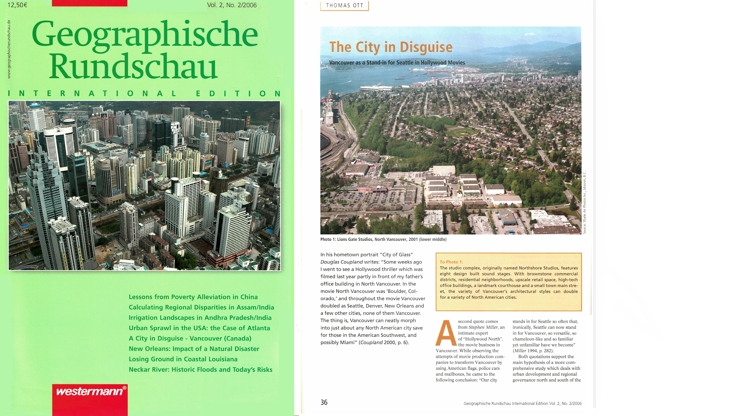
OTT, Thomas (2006): The City in Disguise: Vancouver as a Stand-in for Seattle in Hollywood Movies. Geographische Rundschau International Edition 2 (2), 36-43

Kurzfassung

Pressed by declining profits and ballooning expenses at home, Hollywood has shifted production abroad, particularly the production of low-budget movies made for television. Most are made in Canada, where a weak currency, financial incentives and proximity to the United States make production relatively inexpensive and convenient. Especially Vancouver, British Columbia, has developed into a major location for movie production; the city has become known in the industry as “Hollywood North”. Major studios and independent producers alike are attracted to Vancouver by the abundance of spectacular locations, the highly experienced production teams, the pool of talented local actors and the state-of-the-art post production facilities. However, despite its role as a set for major Hollywood movies, the city is hardly ever identified as itself. It rather acts as a stand-in for American cities, especially Seattle. This process of reducing Vancouver into a mere backdrop by neglecting space and place as a source of stories and characters is fostered by American production companies and the British Columbia Film Commission alike. The scenery of the built urban fabric obstructs, however, the view on inherited, more fundamental differences in social and cultural structures and processes between Canadian and American cities.

Volltext

Projektbeschreibung

Am Beispiel der Städte Vancouver und Seattle untersuchte dieses unvollendet gebliebenen Habilitationsprojekt die Frage nach Gemeinsamkeiten und Unterschieden kanadischer und U.S.-amerikanischer Städte. Als Ausgangshypothese wurde dabei unterstellt, dass der ökonomische Globalisierungsprozess mit seinen sozialen Folgen zu einer Verringerung der Unterschiede zwischen beiden Gesellschaftssystemen und ihren räumlichen (Stadt-) Strukturen führt. Da beide Städte zahlreiche Gemeinsamkeiten aufweisen, war es möglich, konvergente und divergente Faktoren der Stadtentwicklung zu identifizieren, ohne dass der Vergleich durch externe Einflüsse behindert wurde. Als theoretischer Analyserahmen diente der Regulationsansatz, der eine Einbettung der Stadtentwicklungsprozesse in lokale wie globale ökonomische und soziale Akkumulations- und Regulationszusammenhänge erlaubt.

Veröffentlichungen

Vortragspräsentationen

the quick brown fox