OTT, Thomas (1995): Die Stellung der norwegischen Provinzen in einem Europa der Regionen. Petermanns Geographische Mitteilungen 139 (1), 15-30

Kurzfassung

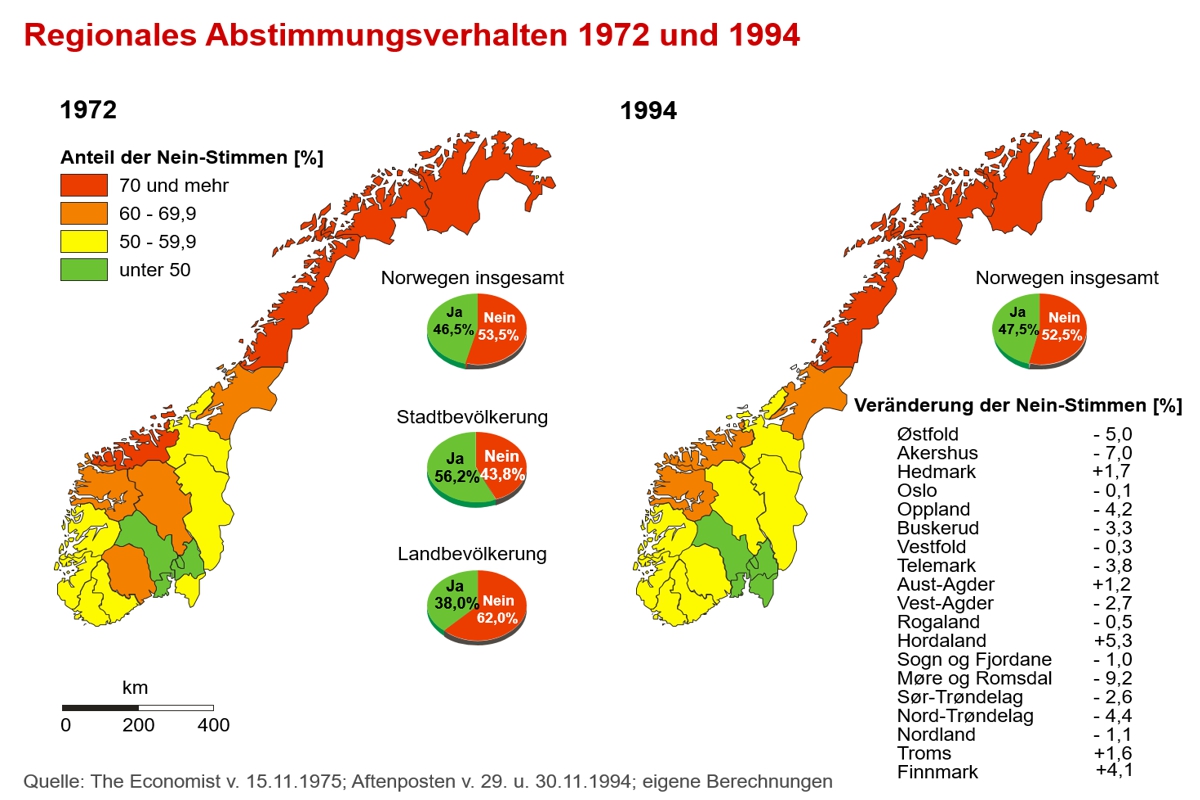
Die norwegische Bevölkerung hat am 28./29. November 1994 nach 1972 dem EU-Beitritt des Landes zum zweiten Mal eine Absage erteilt. Während andere, vor allem mittel- und osteuropäische Staaten auf eine baldige Mitgliedschaft drängen, können es sich die Norweger infolge ihres auf reichhaltigen Bodenschätzen basierenden Wohlstands leisten, der EU fernzubleiben, zumal aufgrund der Mitgliedschaft Norwegens zum Europäischen Wirtschaftsraum (EWR) bzw. zur Europäischen Freihandelszone (EFTA) keine direkten Nachteile einer Nichtmitgliedschaft zu erwarten sind. Im Vergleich zu den Regionen der EU zeigt sich, daß die norwegischen Provinzen, gemessen am Pro-Kopf-Einkommen, an der Arbeitslosigkeit und anderen “Wohlstandsindikatoren”, in der Regel einen überdurchschnittlichen Entwicklungsstand aufweisen, in einigen Fällen (vor allem Oslo) sogar europäische Spitzenplätze einnehmen. Die regionalen Beihilfen im Rahmen der EU-Struktur- bzw. -Kohäsionsfonds bildeten keinen Anreiz für die in besonderem Maße von einem Beitritt betroffenen Gruppen (Landwirte und Fischer), da die von der norwegischen Regierung gezahlten Subventionen deutlich über den EU-Zahlungen liegen, zumal Norwegen als Nettozahler in die Gemeinschaft gekommen wäre. Das Abstimmungsergebnis zeigt, daß vor allem die Bevölkerung in den peripheren, vom primären Sektor geprägten Regionen mit “Nein” gestimmt hat, während die Bewohner des Südens, insbesondere in und um die Hauptstadt Oslo, für den Beitritt optiert haben.
Volltext

STERR, Thomas / OTT, Thomas (2004): The Industrial Region as a Promising Unit for Eco-industrial Development – Reflections, Practical Experience and the Establishment of Innovative Instruments to Support Industrial Ecology. Journal of Cleaner Production 12 (8-10), 947-965

Kurzfassung

Eco-industrial developments with a special focus on material cycles are usually concentrated on the level of the industrial estate. However, the results of completed and ongoing research projects in Germany’s Rhine-Neckar region indicate that larger territorial units may be more suitable for closing material loops and creating sustainable EIPs. In the first part of this article, the authors argue that the industrial region is indeed the most promising level for sustainable development, but that this larger size also presents some new obstacles and challenges: establishing the necessary trust and coordination between actors, homogenizing and collecting data to enable comparisons within and between firms, and minimizing the transaction costs ensuing in the search for appropriate partners by creating transparency. The second part then presents the authors’ practical solutions and IT-tools, which were developed to support a shift towards eco-industrial development on the basis of positive synergy effects for industrial actors. Through these ecologically oriented instruments important prerequisites are fulfilled in order to stimulate an evolutionary shift towards industrial ecology.

Volltext

http://www.sciencedirect.com/science/article/pii/S0959652604000836

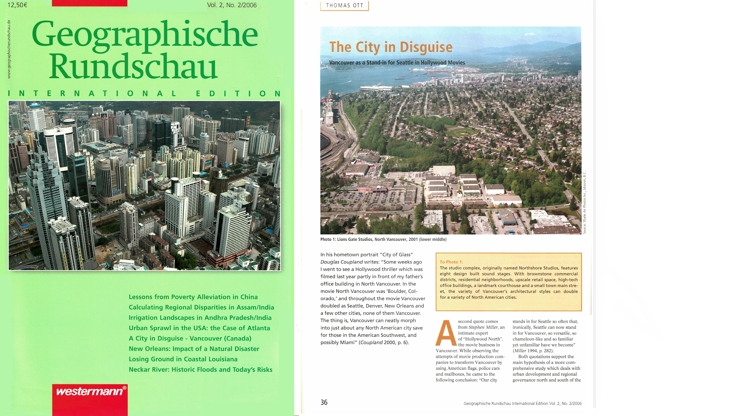
OTT, Thomas (2006): The City in Disguise: Vancouver as a Stand-in for Seattle in Hollywood Movies. Geographische Rundschau International Edition 2 (2), 36-43

Kurzfassung

Pressed by declining profits and ballooning expenses at home, Hollywood has shifted production abroad, particularly the production of low-budget movies made for television. Most are made in Canada, where a weak currency, financial incentives and proximity to the United States make production relatively inexpensive and convenient. Especially Vancouver, British Columbia, has developed into a major location for movie production; the city has become known in the industry as “Hollywood North”. Major studios and independent producers alike are attracted to Vancouver by the abundance of spectacular locations, the highly experienced production teams, the pool of talented local actors and the state-of-the-art post production facilities. However, despite its role as a set for major Hollywood movies, the city is hardly ever identified as itself. It rather acts as a stand-in for American cities, especially Seattle. This process of reducing Vancouver into a mere backdrop by neglecting space and place as a source of stories and characters is fostered by American production companies and the British Columbia Film Commission alike. The scenery of the built urban fabric obstructs, however, the view on inherited, more fundamental differences in social and cultural structures and processes between Canadian and American cities.

Volltext

HORN, Michael / OTT, Thomas / ZEMANN, Christian (2006): Geographical Aspects of the 2006 Football Worldcup in Germany. Geographische Rundschau International Edition 2 (2), Posterbeilage

Kurzfassung

Beilageposter mit Informationen zu den Austragungsorten der Fußballweltmeisterschaft 2006 in Deutschland sowie vergleichenden statistischen Indikatoren der teilnehmenden Länder.

Volltext

pub_GR0602poster


OTT, Thomas (1996): Vom Wesen der Grenze. PH-Report 7 (4), 8-9.
Reprinted in: friZ – Zeitschrift für Friedenspolitik 2/2005, 10-11

Kurzfassung

Grenzen sind ein tagtäglicher Gegenstand der Arbeit eines Geographen. Sie sind Trennungslinien zwischen verschiedenen Gebieten, beispielsweise Staaten, Ländern, Völkern, Kulturkreisen, Klima- und Vegetationszonen, aber auch von individuellen Aktionsräumen.

Volltext

OTT, Thomas (1995): GIS-Einsatz im Rahmen des Projektes „Flächennutzungswandel im Transformationsprozeß von der ‘sozialistischen’ zur ‘kapitalistischen’ Stadt am Beispiel Erfurt. Karlsruher Geoinformatik Report 9 (15/16), 2-5.

Kurzfassung

Ziel des Projektes ist die Erfassung des Flächennutzungswandels im Raum Erfurt zwischen 1989/90 und 1994/95. Durch den Vergleich von LANDSAT-Satellitenbildern erfolgt eine Analyse der großflächigen Flächennutzungsänderungen. Bereiche mit besonders starken oder besonders typischen Veränderungen werden herausgegriffen und detailliert untersucht.

Volltext