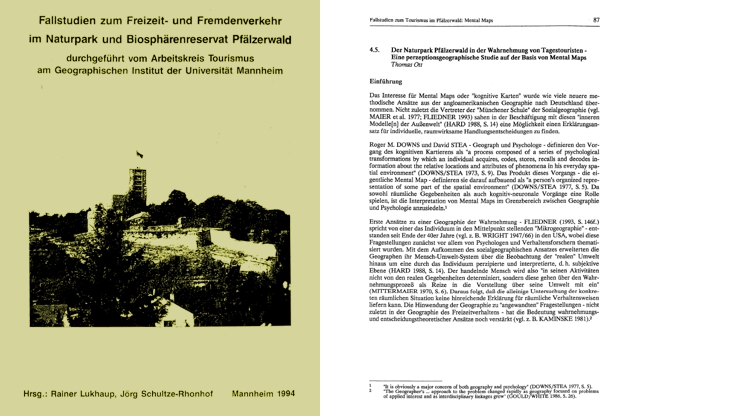
OTT, Thomas (1994): Der Naturpark Pfälzer Wald in der Wahrnehmung von Tagestouristen. Eine perzeptionsgeographische Studie auf der Basis von Mental Maps. In: LUKHAUP, R. / SCHULTZE-RHONHOF, J. (Eds.): Fallstudien zum Freizeit- und Fremdenverkehr im Naturpark und Biosphärenreservat Pfälzerwald. Arbeitsberichte 8, Mannheim: Geographisches Institut, 87-99

Kurzfassung

Ausgangspunkt der Untersuchung war die Frage, welches räumliche Vorstellungsbild den Ausflügen der Tagestouristen im Naturpark Pfälzer Wald zugrunde liegt. Als ein Aspekt dieses Vorstellungsbildes wurde das Problem der “Umgrenzung” bzw. Lage des Pfälzer Waldes herausgegriffen, um in einer empirischen Erhebung eventuelle systematische Verzerrungen bzw. Unsicherheiten zu ermitteln. Dabei wurden drei Grundhypothesen formuliert:

  • Tagestouristen, die den Pfälzer Wald mehrfach bzw. regelmäßig besuchen, entwickeln eine “genauere” räumliche Vorstellung, als jene, die seltener bzw. zum ersten Mal den Pfälzer Wald besuchen.
  • Je näher ein Besucher am Pfälzer Wald wohnt, desto “genauer” stimmt seine Mental Map mit den tatsächlichen Gegebenheiten überein.
  • Bei Besuchern aus weiter entfernten Herkunftsgebieten treten “systematische” Verzerrungen auf, die die gezeichneten Umrisse des Pfälzer Waldes “näher” an das Herkunftsgebiet heranrücken.


Volltext

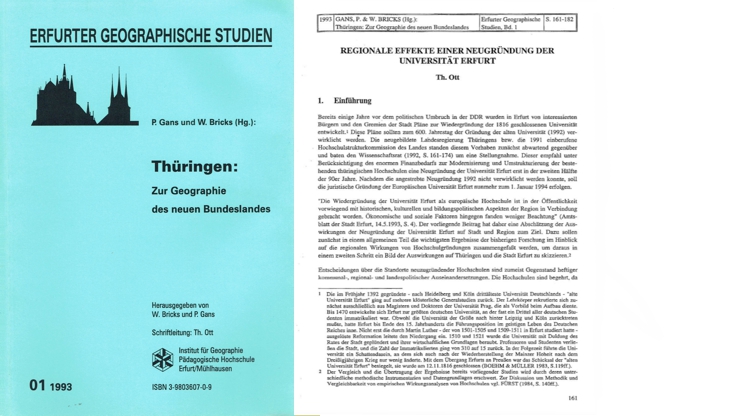
OTT, Thomas (1993): Regionale Effekte einer Neugründung der Universität Erfurt. In: GANS, P. / BRICKS, W. (Eds.): Thüringen – Zur  Geographie des neuen Bundeslandes. Erfurter Geographische Studien 1, Erfurt: Institut für Geographie, 161-182

Kurzfassung

Der Beitrag hat eine Abschätzung der Auswirkungen der Neugründung der Universität Erfurt zum Ziel. Dazu werden in zunächst in einem allgemeinen Teil die wichtigsten Ergebnisse der bisherigen Forschung im Hinblick auf die regionalen Wirkungen von Hochschulneugründungen zusammengefasst, um daraus in einem zweiten Schritt ein Bild der Auswirkungen auf Thüringen und die Stadt Erfurt zu skizzieren.

Volltext

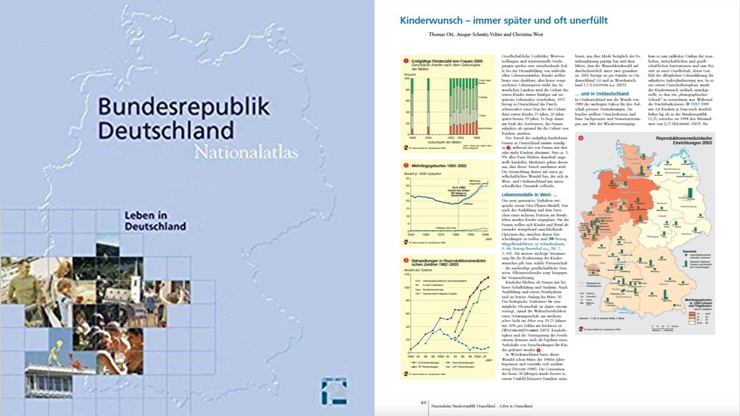
OTT, Thomas / SCHMITZ-VELTIN, Ansgar / WEST Christina (2006): Kinderwunsch – immer später und oft unerfüllt. In: Leibniz-Institut für Länderkunde (Eds.): Nationalatlas Bundesrepublik Deutschland, Bd. 12: Leben in Deutschland, Heidelberg / Berlin: Spektrum, 48-49

Volltext

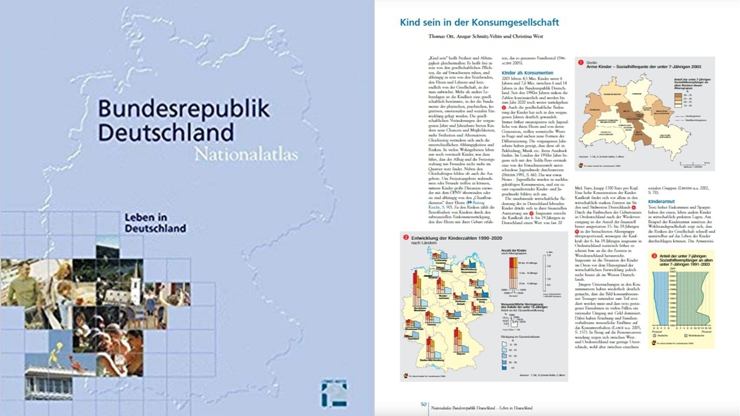
OTT, Thomas / SCHMITZ-VELTIN, Ansgar / WEST Christina (2006): Kind sein in der Konsumgesellschaft. In: Leibniz-Institut für Länderkunde (Eds.): Nationalatlas Bundesrepublik Deutschland, Bd. 12: Leben in Deutschland, Heidelberg / Berlin: Spektrum, 48-49

Volltext

STERR, Thomas / OTT, Thomas (2002): Instruments for the promotion of a sustainability oriented management of waste by inter-industrial coordination within an industrial region. In: European Regional Science Association (Ed.): From Industry to Advanced Services – Perspectives of European Metropolitan Regions, ERSA 2002, Dortmund, Congress CD-ROM

Kurzfassung

The raise of material efficiency is of special importance in the provision of solutions for a more sustainable path of development. One of the main approaches in this direction is the resource saving closure of material circulations among industrial actors. This means at least: maximum rate of recycling combined with a minimum in downgrading processes and spatially close output-input relations – or, in other words: a substantial reduction of social, entropic and spatial distance within the circle-closing process. How can these distances be reduced in order to promote the further spreading of an industrial closed circle economy? What are the present obstacles in the industrial reality and how can they be removed on the level of a firm, an industrial district or an industrial region? These were important questions at the beginning of a research process funded by the Federal Ministry of Education, Science, Research and Technology (BMBF) in order to encourage eco-industrial development in the of Rhine-Neckar region. Taking the results of our close cooperation especially with SME, the problem solving capacity of this industrial region is high enough to close the circles for industrial residues regionally. The dimension of an industrial agglomeration with more than 1,5 million inhabitants could thus already be regarded as a potential output-input system for industrial waste. Nevertheless this capacity is far from being exploited. Taken the fact, that the largest deficiencies were found in the informational situation of SME, two kinds of instruments were developed to facilitate the acquisition and the advantageous usage of waste information by inter-industrial coordination on the level of the industrial region. As informational basis the project coordinators developed a comprehensive, clear and systematic informational structure. A socalled ‘AGUM waste manager’ was developed as a software tool, that meets all the needs not only for internal information and communication but also for exchanges with potentially fitting output-input partners outside the border of the enterprise. As information on the composition of a certain waste is relatively scarce, the transfer of materials goes together with substantial costs for control, that can only be diminished or substituted by mutual confidence between the two actors. And even a pure informational exchange of waste manager-data between different enterprises would hardly work without a face-to-face contact. Our transparency-guided approach to promote regional sustainability did thus include the development and institutionalisation of an inter-industrial network, that first of all incorporates industrial producers (especially SME) but also other actors, that stand for the problem solving capacity of the region (i.e. universities, political administrations and other institutions) and can thus contribute to the identification and implementation of sustainable-oriented solutions in a regional context.

Volltext

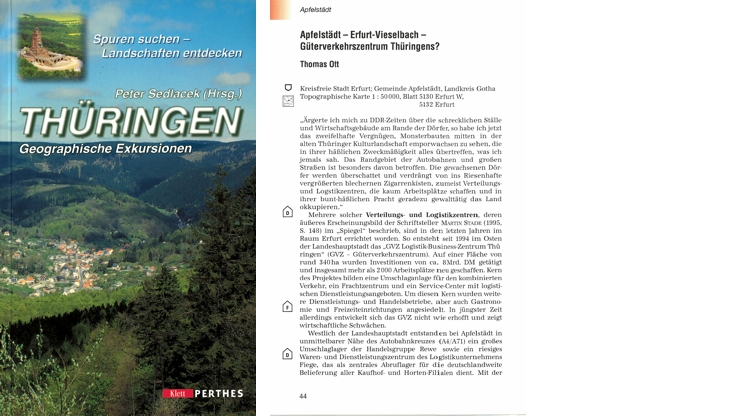
OTT, Thomas (2001): Apfelstädt – Erfurt-Vieselbach – Güterverkehrszentrum Thüringens? In: SEDLACEK, P. (Ed.): Thüringen – Geographische Exkursionen, Gotha: Klett-Perthes, 44-45

Volltext

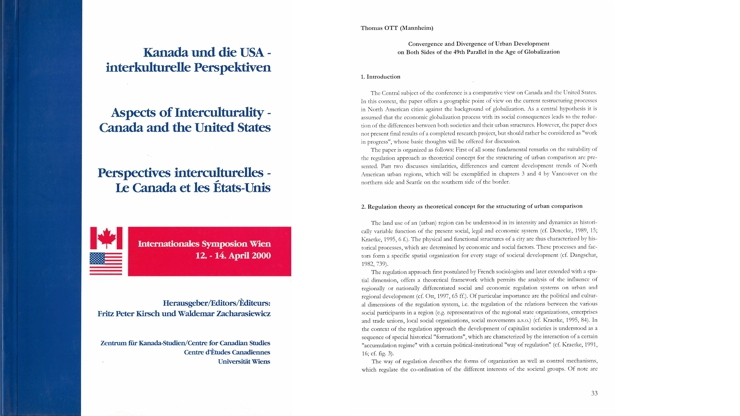
OTT, Thomas (2001): Convergence and divergence of urban development on both sides of the 49th parallel in the age of globalization. In: KIRSCH, F.P. / ZACHARASIEWICZ, W. (Eds.): Kanada und die USA – interkulturelle Perspektiven / Aspects of Interculturality – Canada and the United States / Perspectives interculturelles – Le Canada et les Etats-Unis, Vienna, 33-50

Kurzfassung

Am Beispiel der Städte Vancouver und Seattle untersucht der Vortrag Gemeinsamkeiten und Unterschiede kanadischer und U.S.-amerikanischer Städte. Als Ausgangshypothese wird dabei unterstellt, dass der ökonomische Globalisierungsprozess mit seinen sozialen Folgen zu einer Verringerung der Unterschiede zwischen beiden Gesellschaftssystemen und ihren räumlichen (Stadt-)Strukturen führt. Da beide Städte zahlreiche Gemeinsamkeiten aufweisen, ist es möglich, konvergente und divergente Faktoren der Stadtentwicklung zu identifizieren, ohne dass der Vergleich durch externe Einflüsse behindert wird. Als theoretischer Analyserahmen dient der Regulationsansatz, der eine Einbettung der Stadtentwicklungsprozesse in lokale wie globale ökonomische und soziale Akkumulations- und Regulationszusammenhänge erlaubt.

Volltext

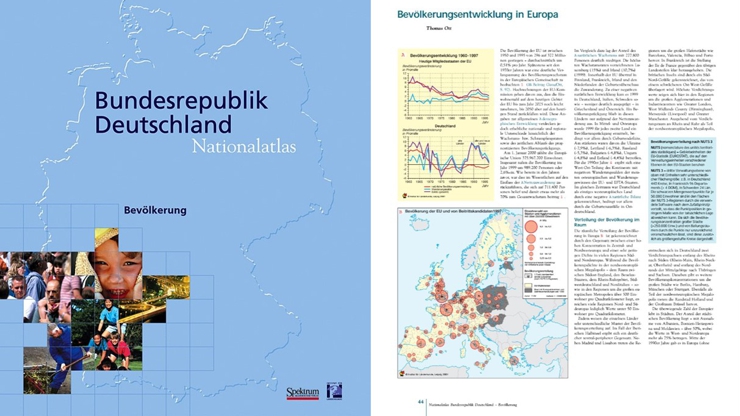
OTT, Thomas (2001): Bevölkerungsentwicklung in Europa. In: GANS, P. / KEMPER, F.-J. (Eds.): Nationalatlas Bundesrepublik Deutschland, Bd. 4: Bevölkerung, Heidelberg / Berlin: Spektrum, 44-45

Volltext

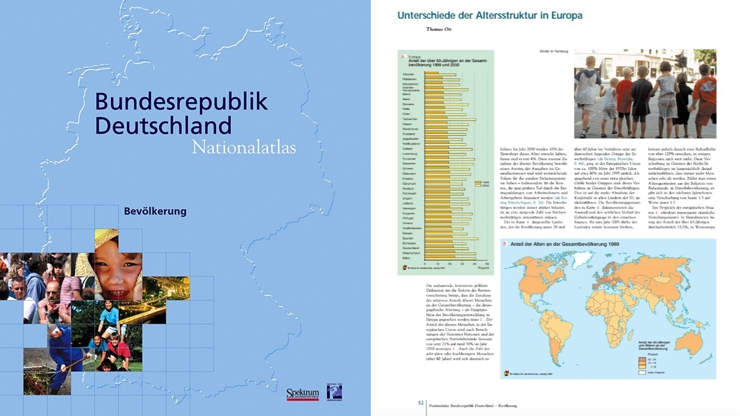
OTT, Thomas (2001): Unterschiede der Altersstruktur in Europa. In: GANS, P. / KEMPER, F.-J. (Eds.): Nationalatlas Bundesrepublik Deutschland, Bd. 4: Bevölkerung, Heidelberg / Berlin: Spektrum, 52-53

Volltext